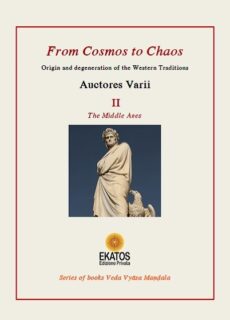
As the publication of the second part of From Cosmos to Chaos is near, we present an excerpt from the introduction to the second volume, edited by one of the authors, Professor Gian Giuseppe Filippi. This volume deals with the Middle Ages, precisely from the crisis of the Carolingian Empire to the destruction of the Order of the Knights of the Temple. A period of time in which alongside the splendor of a civilization that reached its apogee, one can see the shadows that would have characterized the following era, the modern one, the hallmark of which is an obsessive and unbridled anti-traditional action. For this reason, we believe that reading this book, like the rest of the series dedicated to this theme, can be a valid support for developing the ability to truly understand the world in which we live. Moreover, the purpose of this series of studies is to clarify ” the ideas of the Hindū Authorities” about some basic concept of Western Traditions, giving reason for modern degeneration. In this way we want to return a correct information to such generously lavished wisdom.
For this we want to thank all the Authors and the Tridaṇḍa Editorial Committee for their commitment and the courage shown in contrasting a mentality that even in cultural and spiritual circles has flattened and crystallized on stereotyped and profane positions, far from that Primordial Tradition that still today it is the only bulwark against the rampant deluge of ignorance barbarism.
From the Introduction:
“Through the reading of this new collection of articles, it is possible to follow the attempted foundation of an initiation-led complete tradition, under the aegis of the new Christian religion, expression of a conscious elite and under the guidance of high-ranking personalities of undoubted inner realization. The plan took inspiration from the ancient Roman Empire model, the only true backbone for a traditional renewal, which would have brought forth the knowledge and the initiatic hierarchy in both a religious and a social form. The grandeur of the project cannot be denied despite the failing by the Holy Roman Empire in the practical realization of that plan, also due to the structure of the ecclesiastical form of the exterior religion which was proven inadequate and, over time, increasingly unreliable.
Certainly, the tradition was well established in both its esoteric and exoteric components. In the field of esotericism, the confluence in a single stream of transmissions proceeding from the different sources such as Romanity, Druidism and Christianity, was carried out harmoniously and without any syncretism. In exotericism, the Imperial state structure, namely the feudalism, gave birth to free social classes, well defined and harmonized in their competences and social functions, although only the noble class managed to assume a nature comparable to that of the casts of Hinduism. However, the monasticism of Hesychasm, the chivalry and the craft guilds, carried out, for a long time, the correct task of connecting the tradition’s interior and exterior forms.
Certainly, the part of mankind this attempt was directed to, proved to be extremely decayed and corrupt, thus revealing its degree of sinking into the Kaliyuga. It is therefore no wonder that the implementation of the plan was constantly hindered or openly opposed. Undoubtedly all this was due to the action of dualistic and pauperist heretical currents, the birth of greedy national kingdoms, the formation of a rich mercantile class, the particularism of the bourgeois communes, and above all, the direction of the papacy which promoted and headed all those subversive pressures. However, the violent eradication of the tradition in Europe coincided with the achievement of the acme of doctrinal production, incomparably superior to any other monument of Western thought in living memory. This still remains largely unknown or incomprehensible to the general public, but represents a legacy for anyone able to understand and revive it.”

0 commenti